
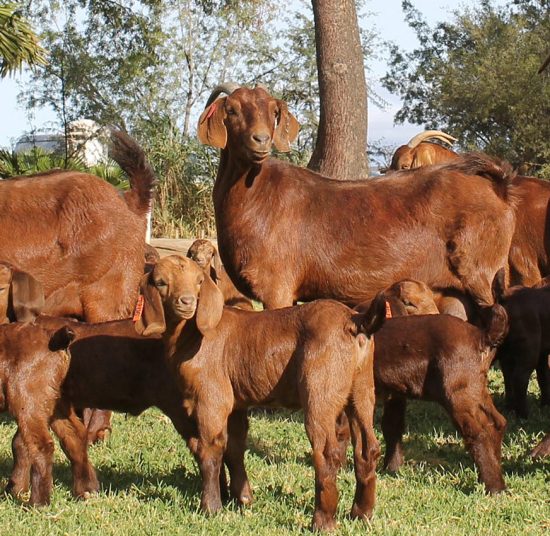

Kalahari Red goats are a highly valued South African meat-goat breed renowned for their hardiness, excellent adaptability, strong fertility, maternal ability, efficient grazing, rapid growth, and quality meat-production potential. Developed in the harsh conditions of Southern Africa, the breed is particularly well suited to hot, dry, and challenging environments.
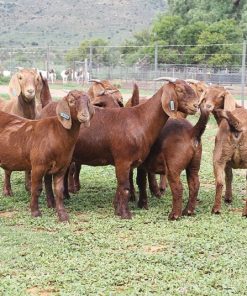
Recognized by their distinctive reddish-brown coat, Kalahari Red goats combine attractive appearance with practical production qualities. Their natural resilience allows them to utilize a variety of grazing and browsing resources while maintaining good reproductive and growth performance under appropriate management.
Our Kalahari Red goats are carefully managed through responsible breeding, quality nutrition, preventive healthcare, and professional livestock practices to support healthy growth, high reproductive performance, strong kid survival, and long-term flock productivity.
Key Attributes of Kalahari Red Goats
- Exceptional Hardiness: Naturally resilient and capable of performing under demanding environmental conditions.
- Excellent Adaptability: Well suited to hot, dry, tropical, and semi-arid climates.
- Strong Heat Tolerance: Their Southern African heritage makes them particularly suitable for warm environments.
- Excellent Meat Production: Bred primarily for efficient and productive meat production.
- Fast Growth: Good growth potential allows kids to develop efficiently when properly nourished.
- Strong Fertility: Productive does can contribute to rapid and sustainable flock expansion.
- Good Kid Survival: Strong maternal ability and adaptability can support healthy offspring when combined with proper management.
- Excellent Maternal Ability: Does are valued for their mothering instincts and ability to raise healthy kids.
- Efficient Grazing & Browsing: Can utilize grasses, shrubs, leaves, and other available forage resources.
- Strong Disease & Parasite Resilience: Their natural adaptation can provide useful resilience in challenging environments, alongside appropriate veterinary care.
- Low-Input Potential: Suitable for extensive and pasture-based systems.
- Excellent Crossbreeding Value: Kalahari Red genetics can introduce hardiness, adaptability, growth, and meat-production traits into suitable crossbred herds.
Kalahari Red Goat Meat & Meat Quality
Kalahari Red goats are primarily bred for high-quality meat production. Their strong frame, muscular development, and efficient growth make them valuable for commercial and smallholder meat-goat operations.
When animals are appropriately nourished, handled, finished, and processed, they can produce lean, flavorful, and tender goat meat.
Key meat-production attributes include:
- Good lean-meat yield
- Strong muscular development
- Good carcass potential
- Efficient growth
- Desirable meat flavor
- Tender meat when appropriately managed
- Good finishing potential
- Suitability for commercial goat-meat markets
Final meat quality depends on genetics, nutrition, animal age, growth rate, handling, slaughter practices, processing, and meat-aging or storage conditions.
Kalahari Red Goats for Commercial Meat Production
Kalahari Red goats are an excellent choice for commercial meat production because they combine growth, fertility, adaptability, hardiness, efficient grazing, and strong maternal performance.
They can perform effectively in extensive, semi-intensive, and more intensive production systems. Their ability to make use of natural browse and pasture can be especially valuable for farmers seeking efficient livestock production in environments where feed resources may fluctuate.
Kalahari Red Does for Breeding
Kalahari Red does can form a productive foundation for commercial breeding flocks. Their fertility, maternal characteristics, adaptability, and ability to raise healthy kids make them valuable for both small-scale and commercial goat enterprises.
Breeding selection should focus on:
- Fertility
- Kidding performance
- Kid survival
- Maternal ability
- Udder quality
- Body structure
- Growth performance
- Temperament
- Overall health and adaptability
Good nutrition before breeding and throughout pregnancy and lactation is essential for maintaining healthy and productive does.
Kalahari Red Bucks
Kalahari Red bucks are valuable for purebred breeding and commercial crossbreeding programs. Carefully selected bucks can contribute desirable traits such as growth, muscling, fertility, hardiness, adaptability, and meat-production ability.
Breeding bucks should be selected for sound structure, reproductive health, body condition, desirable conformation, temperament, and genetic performance.
Adaptability to Hot & Dry Environments
One of the defining advantages of Kalahari Red goats is their ability to perform in hot, dry, and semi-arid environments. Their natural adaptation enables them to make effective use of available vegetation while coping with challenging climatic conditions.
This makes them particularly suitable for tropical and subtropical regions. Nevertheless, proper management remains essential. Clean water, quality forage, shade, mineral supplementation, parasite control, and veterinary care help maximize their productivity.
Quality Nutrition & Farm Management
Kalahari Red goats are efficient foragers, but good nutrition remains important for achieving their genetic potential.
A balanced feeding program should provide:
- Quality pasture and browse
- Clean drinking water
- Essential minerals
- Adequate protein and energy
- Supplementary feed during drought or feed shortages
- Additional nutrition for pregnant and lactating does
- Appropriate nutrition for rapidly growing kids
Good nutrition supports fertility, pregnancy, milk production, kid survival, growth, and meat quality.
Health & Animal Welfare
Responsible herd management is essential for maintaining healthy Kalahari Red goats. Regular health monitoring, appropriate vaccination programs, parasite control, veterinary care, clean housing, and careful handling help support animal welfare and productivity.
Providing adequate space, nutritious feed, fresh water, shade, shelter where necessary, and safe grazing areas contributes to healthy and productive animals.
Uses of Kalahari Red Goats
Kalahari Red goats are suitable for a wide range of livestock applications, including:
- Commercial meat production
- Goat breeding
- Kid production
- Purebred herd development
- Crossbreeding programs
- Commercial goat farming
- Smallholder livestock farming
- Pasture and browse-based production
- Tropical and subtropical goat farming
- Semi-arid livestock production
- Genetic improvement programs
- Climate-resilient livestock production
- Flock expansion
Why Choose Kalahari Red Goats?
Kalahari Red goats offer an outstanding combination of hardiness, fertility, rapid growth, strong maternal ability, kid survival, heat tolerance, efficient grazing, and quality meat production.
Their natural ability to perform in challenging environments makes them an excellent choice for farmers looking to develop a resilient and productive meat-goat enterprise. Their genetics can also be valuable in crossbreeding programs where improved adaptability, growth, and meat-production performance are desired.
Whether you are establishing a new goat farm, expanding an existing flock, selecting breeding stock, producing kids for the meat market, or developing a climate-resilient livestock operation, Kalahari Red goats provide a strong foundation for efficient, sustainable, and commercially productive goat farming.
Our Commitment
We are committed to providing healthy, well-managed Kalahari Red goats for farmers, breeders, ranchers, and commercial livestock producers. Through responsible breeding, quality nutrition, preventive healthcare, and professional herd management, we aim to support strong flocks and reliable meat production.
With their distinctive red coat, exceptional resilience, strong reproductive ability, and excellent meat-production characteristics, Kalahari Red goats are an ideal choice for farmers seeking hardy genetics, productive animals, and long-term livestock value.
Hardy Genetics. Strong Fertility. Fast Growth. Quality Meat. Exceptional Adaptability.


Reviews
There are no reviews yet.